Overview
A molecule can contain several useful substructures, and the same fixed grouping rule may miss how those parts vary from one molecule to the next. The authors design a graph pooling layer that starts by scoring whether pairs of nodes belong together. It uses the resulting grouping matrix to summarize the graph for a property prediction.
Key Findings
Why a fixed number of clusters fits molecules poorly
Picture a chemist sorting two molecules into functional groups, which are small clusters of atoms that tend to drive a molecule's behavior. One molecule may split into two natural groups and another into six. Most graph pooling layers, which shrink a graph into a smaller summary, ask the user to pick one cluster count in advance and apply it to every graph. Moontae and his colleagues argue that this assumption adds a strong bias and forces extra hyperparameter tuning. Their method, GMPool, removes the cluster count from the user's hands.
A pairwise question replaces a cluster label
Instead of asking which cluster each atom belongs to, GMPool asks whether each pair of atoms belongs together. A classifier scores every pair of node features and fills a grouping matrix :
This is the paper's Eq. 5. Here is the feature vector of node and is a symmetric function of the two inputs. The authors use Euclidean distance between the two feature vectors. Entry reads as the probability that the two nodes share a group. Scoring all pairs keeps the result independent of node ordering. If groups never overlapped, would be block diagonal with blocks of ones, so the number of blocks would equal the number of groups. In practice entries are continuous values between 0 and 1, which allows soft, overlapping clusters. The reported setup builds with a 200 × 1 linear layer and a sigmoid, with no parameter tied to cluster count.
Taking the square root of the grouping matrix
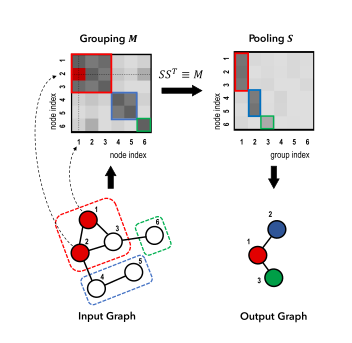
The grouping matrix is not a pooling operator itself. The authors observe that a pooling matrix multiplied by its own transpose gives :
This is Eq. 9. GMPool therefore recovers by decomposing . With an eigendecomposition , it sets . Zero eigenvalues switch off unneeded directions, so the effective rank of sets the cluster count for each graph. The coarsened graph follows from , and , which update node features, edge features and the adjacency matrix. Figure 1 follows the operation from the original graph to the pooled representation. All of this sits on a directed message passing network (DMPNN) backbone, although the authors say the layer can attach to any GNN that outputs node representations.
Keeping gradients stable
Small gaps between eigenvalues make the standard backward pass blow up, because the gradient contains terms like . The authors adopt approximate-gradient methods from earlier work, which that work reports to be over 8 times faster than standard SVD. The cost is that approximation error grows with matrix size, so the authors caution that the approach may not suit large graphs. They also report that small-eigengap corner cases still cause non-convergence in about 0.00018% of their experiments.
A cheaper variant without decomposition
NGMPool skips the decomposition and aggregates with the grouping matrix directly, using and . It costs and works only for a single pooling depth, since different pooling operators do not commute. The authors also note that common activation functions are not equivariant with pooling operators and presume the effect is small. They report it performs comparably to GMPool.
What the benchmarks show
The experiments use five datasets: three fluorescence sets (PLQY with 515 molecules, λmax Solvents with 1,070, λmax Films with 1,270), a binding set (pIC50, 10,978) and a toxicity set (Tox21, 2,514). Models run under five-fold splits with a 10% test set. Molecules under 20 nodes are dropped, and Tox21 and pIC50 molecules over 40 nodes are dropped too, so results describe those subsets. Baselines that need a cluster count get a fixed final size of 10, chosen from the average size of common functional groups.
| Model | PLQY RMSE ↓ | λmax Films RMSE ↓ | pIC50 RMSE ↓ |
|---|---|---|---|
| DMPNN | 0.2414 | 35.10 | 0.7839 |
| SAGPool | 0.2123 | 37.98 | 0.7956 |
| GMPool | 0.2091 | 34.34 | 0.6951 |
| NGMPool | 0.2169 | 39.82 | 0.7253 |
These are selected rows from Table 2, where lower root-mean-square error is better. GMPool leads all three columns shown. On the full table, NGMPool takes λmax Solvents (38.61) and Tox21 ROC-AUC (0.7617), so the lead varies by task. The size of the advantage depends on the target property, with narrower margins on the two wavelength regression sets. Their explanation is that complicated groupings need higher rank than a fixed small cluster count allows. That explanation is the authors' interpretation, and the paper does not test it directly.
Forcing a cluster count, and where it goes next
In an ablation on PLQY (Figure 3), the authors force GMPool to use specific cluster counts. Setting the count equal to the node count costs no performance, and GMPool beats Top-k at several values and the plain DMPNN. They argue that truncating to the top eigenvalues can lose information, especially early in training, so letting the model choose is best. Figure 2 shows grouping matrices moving from a random start toward intuitive groups for PLQY and more complex patterns for λmax. Compare the grouping matrices in Figure 2.
The authors list open directions. Faster decomposition could ease the SVD bottleneck, though they expect some accuracy loss. Higher-order grouping tensors could capture more than pairs, but their cost grows steeply with node count, so the authors left that untested.
Questions & Answers
Q: Why compare pairs of atoms?
A: A pairwise affinity expresses which nodes the model should summarize together without giving every possible group a predefined identity. It also makes the grouping rule independent of the order in which nodes are listed.
Q: Why use two pooling variants?
A: The decomposed operator can be used in a hierarchy, but the matrix operation adds cost. Direct aggregation is simpler and scales better in the reported design, with a single-depth restriction.
Q: What does a learned group tell a chemist?
A: It suggests which atoms the model represents together for its prediction. The group can be compared with a known functional unit or tested by perturbing related molecules.
Q: What limits the evidence for running adaptive pooling on bigger molecules?
A: The tested molecules are filtered by size and the grouping matrix covers all atom pairs, making memory grow quadratically with graph size. The decomposition gradient is approximate and can become less reliable on larger matrices or when eigenvalues are close. The measured gains establish a starting point for evaluating size and stability together.
Future Ideas
Check whether a learned group predicts what a substitution will change
Train pooling models on measured fluorescent compounds. Hold out whole scaffold families and collect matched pairs that differ by a small substitution. Compare the predicted property changes from adaptive pooling, fixed-size pooling, and a simple molecular fingerprint.
Measure error on property differences as well as on absolute values. Record whether the learned group around a changed site is stable across nearby compounds, and test whether masking the group changes the prediction more than masking a size-matched random subgraph. Report performance by molecule size and include inference cost.
Document the scaffold-split rule, the source of the fluorescence measurements and the assay conditions so a second lab can repeat the comparison.
Sources
Original abstract
Graph pooling is a crucial operation for encoding hierarchi- cal structures within graphs. Most existing graph pooling approaches formulate the problem as a node clustering task which effectively captures the graph topology. Conventional methods ask users to specify an appropriate number of clusters as a hyperparameter, then assume that all input graphs share the same number of clusters. In inductive settings where the number of clusters can vary, however, the model should be able to represent this variation in its pooling layers in order to learn suitable clusters. Thus we propose GMP OOL, a novel differentiable graph pooling architecture that automatically de- termines the appropriate number of clusters based on the input data. The main intuition involves a grouping matrix defined as a quadratic form of the pooling operator, which induces use of binary classification probabilities of pairwise combinations of nodes. GMP OOL obtains the pooling operator by first com- puting the grouping matrix, then decomposing it. Extensive evaluations on molecular property prediction tasks demon- strate that our method outperforms conventional methods.