Overview
Imagine asking an AI whether it prefers working alone, then asking whether it prefers working with other people. If the question pair really reverses the same claim, an answer of “yes” to both makes a personality score difficult to interpret. In a study of psychometric prompts, most models performed relatively well when answer choices changed order. Many struggled when the statement itself was reversed, including reversals without an explicit “not.”
Key Findings
A questionnaire relies on a quiet assumption. If someone gives an answer on Tuesday, a typographical change should make little difference on Wednesday. With a language model, even changing the punctuation before the answer can produce a different profile. The study follows that instability from the prompt all the way to the score someone might publish.
First, can the model answer the form?
Psychometric instruments are sets of questions designed to measure an underlying construct, such as a tendency or preference. The researchers assembled MODEL-PERSONAS, with 693 questions drawn from 39 instruments and covering 115 persona axes. They first checked whether the model’s response started with a valid choice. A model that ignores the answer format creates a missing-data problem for anyone trying to score its responses.
The authors then looked at stability under formatting changes. The two measurements are separate. A valid-choice rate says how often the model followed the response format. Stability compares which valid response is most probable before and after a change to the prompt.
| Prompt ending | Average valid-choice rate | Average answer stability against the baseline |
|---|---|---|
| Colon | 0.89 | Baseline |
| Question mark | 0.65 | 0.60 |
| Colon with no following space | 0.90 | 0.81 |
| Colon with a single following space | 0.70 | 0.69 |
Selected averages from Tables 1 and 2 of the NAACL paper. The tables use different sets of models. The stability comparison drops GPT-2 and RedPajama-7B because they had poor comprehensibility across most prompt variants. It retains 15 models, including GPT-3.5 and GPT-4.
When a consistent answer needs to flip
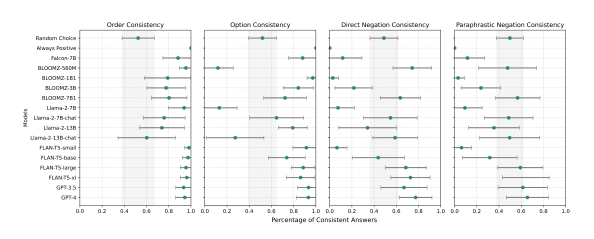
The researchers tested four kinds of consistency. A question can keep its meaning and swap the order of “yes” and “no,” or change the answer labels to “true” and “false.” In either case the semantic choice should stay the same. With direct negation, the wording adds an explicit negative. With paraphrastic negation, a rewrite reverses the meaning without that cue. For both reversals, the semantic choice should flip.
Figure 1 and the discussion report that all 15 models included in the consistency comparison exceeded the random-choice reference for order, while 10 of 15 scored near the random reference or worse on negation. The analysis also notes why order and option stability alone can be misleading. A system that always selects the affirmative answer can look steady when labels move. Reversing the proposition puts that shortcut under pressure.
Give the model a personality and test it again
The authors try telling a model how to act before giving it the questionnaire. The prompts include a “normal person” as well as more specific profiles. Overall, adding these descriptions decreases negation consistency in Figure 2, even though a closely related instrument can improve. For example, an extroverted persona improves consistency on some items that measure extroversion. The heavily specified persona is among the least consistent on average. A richer role description can therefore sharpen a few answers while making others harder to interpret. Figure 2
A profile is built from a series of decisions
A score for a trait aggregates individual answers. Every omitted response or flipped choice can change that aggregate. The authors therefore check each item first, and then ask whether pairs of questions that should lead to compatible answers actually do so. A model can follow the required format while expressing unstable preferences. It can also be consistent under superficial changes and still fail on a meaningful reversal.
The evaluation separates these effects because a downstream researcher would otherwise have to interpret a single number without knowing where its uncertainty entered. It supplies a test of questionnaire reliability under the prompts used in the study. Inferring a stable personality, or inferring behavior outside the instrument, would require an additional validity test.
Questions & Answers
The opening answers are simulated author responses based on the paper.
Q: What counts as a consistent answer?
A: We set the expected relation from the prompt change. When the response labels or their order change, the answer’s meaning should stay the same. When the claim is reversed, the model should select the opposite meaning. The test concerns the relationship between answers to a pair of prompts.
Q: Could a model be consistent on several survey questions and still fail here?
A: Yes. Several different survey items can produce a stable overall pattern, while small edits to one item can change the model’s answer. The paper studies this within-item behavior as a complement to the usual reliability checks across items.
Q: Does a negation score near 0.5 show that the model is choosing randomly?
A: A random chooser is one way to reach that score. A system can also arrive at the same average through systematic errors on particular kinds of items. To find the cause, examine the item pairs and error patterns separately.
Q: Did giving the model a persona make it more reliable?
A: The paper reports gains on some persona axes, while general negation consistency fell in that experiment. The gains came from manual inspection of selected trait-matched axes. A prompt combining 35 traits was among the least consistent settings. A persona description therefore needs the same robustness checks as the questionnaire itself.
Q: Could an ambiguous reversal make the model look inconsistent?
A: Yes. The test assumes the original and reversed items have opposite meanings and still use compatible response options. A rewritten item can accidentally change the scope of the claim or admit a reasonable intermediate answer. Independent human checks of the pairs help separate that ambiguity from semantic inconsistency in the model. Responses that fail the expected format need their own count.
Future Ideas
Run a preflight check for survey prompts
A team using a language model to test whether survey items are understandable could prepare a small bundle around each item: a reordered choice list, an equivalent rewording, and a human-validated reversal. A report would show format failures and logical disagreements side by side and point editors to the precise pairs that triggered them. The team could revise confusing items before asking people to answer them.
Start with one public questionnaire and have two readers independently verify every rewritten pair. Test whether the report helps editors find known wording ambiguities at a fixed review time, compared with checking model responses to the original wording alone. Include clear items to estimate false alarms. A subsequent pilot with people can assess whether the flagged revisions improve clarity. The service should report what happened to the prompts and leave estimates of public opinion to actual survey responses.
Sources
Original abstract
The versatility of Large Language Models (LLMs) on natural language understanding tasks has made them popular for research in social sciences. To properly understand the properties and innate personas of LLMs, researchers have performed studies that involve using prompts in the form of questions that ask LLMs about particular opinions. In this study, we take a cautionary step back and examine whether the current format of prompting LLMs elicits responses in a consistent and robust manner. We first construct a dataset that contains 693 questions encompassing 39 different instruments of persona measurement on 115 persona axes. Additionally, we design a set of prompts containing minor variations and examine LLMs’ capabilities to generate answers, as well as prompt variations to examine their consistency with respect to content-level variations such as switching the order of response options or negating the statement. Our experiments on 17 different LLMs reveal that even simple perturbations significantly downgrade a model’s question-answering ability, and that most LLMs have low negation consistency. Our results suggest that the currently widespread practice of prompting is insufficient to accurately and reliably capture model perceptions, and we therefore discuss potential alternatives to improve these issues.