Overview
A photograph and a generated image may look alike at normal size. Moontae and his team ask whether a model trained to recognize images across many crops can still tell them apart. Their detector compares two representations of each patch, one from the original and one from a version with some fine-scale detail removed. It aggregates those comparisons without fitting a separate classifier on real and synthetic examples.
Key Findings
Crop a photograph and the subject often remains recognizable. Change how a detector sees the texture within the crop and its representation may move. The researchers use that response to a controlled change as evidence about the image’s source.
Turn the pretraining exercise into a test
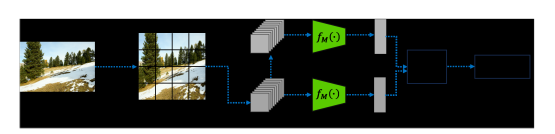
DINOv2 learns from differently cropped and resized views of an image. The authors hypothesize that its representations of real images will be comparatively stable under changes to high-frequency information, meaning rapid changes between neighboring pixels. A Haar wavelet decomposition separates coarse image structure from detail at finer scales. The detector removes a fraction of the detail and measures the cosine similarity between the original and modified embeddings. A higher similarity is evidence of greater stability under the perturbation. It does not identify which generator created an image.
The method first resizes the full image to a square grid, divides it into equally sized patches, and scores each patch. Its final score is the arithmetic mean of those patch similarities. The Synthbuster demonstration uses a 1,344-pixel square with 224-pixel patches, giving 36 patch comparisons. GenImage and Deepfake-LSUN-Bedroom use 896 pixels and 16 patches. This is an inference-time procedure on a pretrained image encoder, so “training-free” refers to the detector. Method and equations
A useful signal with clear exceptions
| Detector | Synthbuster mean AUROC | GenImage mean AUROC | Deepfake-LSUN-Bedroom mean AUROC |
|---|---|---|---|
| AIDE, training-based | 0.648 | 0.969 | 0.825 |
| AEROBLADE, training-free | 0.703 | 0.928 | 0.522 |
| Manifold Bias, training-free | 0.565 | 0.736 | 0.920 |
| WaRPAD, training-free | 0.834 | 0.946 | 0.934 |
AUROC summarizes the ability to rank examples from the two classes across possible thresholds. The reported means are across generators in each benchmark. WaRPAD leads the training-free methods in these tables. AIDE has the higher mean on GenImage, and WaRPAD scores 0.422 on DALL-E 3 in Synthbuster, where all reported methods are at or below 0.486. Figure 6 tests JPEG compression, center crop, and Gaussian noise on GenImage. Appendix Figure 8 covers Synthbuster. Table 8 shows that results also depend on the choice of backbone. Tables 2–4 · Corruption tests
Read the perturbation as a controlled comparison
For embeddings and before and after the wavelet perturbation, cosine similarity is
It is high when the vectors point in similar directions. The detector applies the comparison across patches because resizing one full image could discard the local structure the perturbation is meant to reveal. The change is made in wavelet details at selected scales, which keeps the comparison tied to a specific kind of image information.
Equation 3 makes the pooling choice explicit. With patches and the cosine-based wavelet score for patch , the image score is
Table 5 checks whether running a detector several times could explain the improvement. On Synthbuster, the ordinary RIGID baseline records 0.587 AUROC. Its compute-matched ensemble reaches 0.589. Combining RIGID with the proposed patching reaches 0.656, while the full wavelet-and-patching detector reaches 0.834. On GenImage, the isolated wavelet score reaches 0.809, below RIGID’s 0.820. In these tests, the combination supplies more than either component on its own. See the component and patch-size comparisons on PDF page 8.
The detector meets images outside the clean benchmark
The experiments compare several kinds of generation and editing, and the analysis tests sensitivity to image corruptions. Those tests matter when a detector will receive resized or processed files. A method can rank clean benchmark images well and still need calibration for a different mixture of transformations. The study measures that robustness separately from its headline detection scores.
Questions & Answers
The opening answers are simulated author responses based on the paper.
Q: Why look at a patch instead of the whole image?
A: An embedding of a whole image can stay similar even if some local details shift. Our procedure compares smaller views and combines the results. It is inspired by the crops used during representation learning.
Q: Does a high score settle whether a photo is real?
A: The score measures representation stability under a specific image perturbation. A real photo can score unexpectedly, and a generated image can be stable. The benchmark tells us how the score separates tested groups of images.
Q: Can the same scoring rule use a different vision model?
A: We tested several backbones. The benefit was more consistent for the models trained to be invariant to crop augmentations. With BeiT, a masked-image-modeling encoder, our score fell below RIGID.
Q: What does AUROC tell a newsroom about false alarms on real photos?
A: AUROC summarizes ranking across thresholds. A newsroom acts at one threshold, where the rate of false alerts depends on its own mix of devices, compression, edits, and generators. The paper's aggregate and generator-specific results therefore need a threshold test on authentic submissions before anyone can estimate how much extra review the score creates.
Future Ideas
Run the detector in a newsroom's shadow queue
Replay a stream of consented newsroom submissions with known provenance, including authentic low-light and heavily compressed photos, synthetic images from held-out generators, and images with benign edits. Run a simple provenance-and-metadata baseline and then add the WaRPAD score. Use the score to prioritize requests for an original file while keeping editorial decisions with reviewers.
Predeclare a low false-alert budget on authentic photos and measure the share of synthetic images surfaced within that budget. Track reviewer time and subgroup performance by device and processing pipeline. Treat mixed-source images as a separate evaluation set. Continue only if the combined queue improves review efficiency without raising the authentic-photo false-alert rate.
Log encoder calls and processing time, especially for large images. Compare queues at the same false-alert budget and report whether patching still earns its additional cost.
Sources
Original abstract
AI-generated image detection has become crucial with the rapid advancement of vision-generative models. Instead of training detectors tailored to specific datasets, we study a training-free approach leveraging self-supervised models without re- quiring prior data knowledge. These models, pre-trained with augmentations like RandomResizedCrop, learn to produce consistent representations across varying resolutions. Motivated by this, we proposeWaRPAD, a training-free AI-generated image detection algorithm based on self-supervised models. Since neighborhood pixel differences in images are highly sensitive to resizing operations, WaRPAD first defines a base score function that quantifies the sensitivity of image embed- dings to perturbations along high-frequency directions extracted via Haar wavelet decomposition. To simulate robustness against cropping augmentation, we rescale each image to a multiple of the model’s input size, divide it into smaller patches, and compute the base score for each patch. The final detection score is then ob- tained by averaging the scores across all patches. We validate WaRPAD on real datasets of diverse resolutions and domains, and images generated by 23 different generative models. Our method consistently achieves competitive performance and demonstrates strong robustness to test-time corruptions. Furthermore, as invari- ance to RandomResizedCrop is a common training scheme across self-supervised models, we show that WaRPAD is applicable across self-supervised models.