Overview
Suppose one answer is a little clearer than another. Now suppose an answer invents a source while its alternative cites the right one. Both pairs supply the same training label: one answer won. The size of the preference is missing. Moontae and his team train a discriminator on the same pairwise data to score how likely each answer is to belong to the preferred group. Their method, Implicit Policy Regularized Preference Optimization, uses those scores to adjust the training margin.
Key Findings
A model can learn a preferred response by asking how much more likely it should be than a rejected one. The choice of reference matters. If the reference rarely writes responses resembling the preferred answers, its probabilities can set an awkward baseline for learning from the pairs.
The reference behind preference training
Direct Preference Optimization, or DPO, raises the relative probability of a preferred answer over a rejected one using a fixed reference policy as a baseline. Keeping a reference can stabilize learning. If that reference rarely produces the kinds of answers people want, its likelihoods can make it harder to learn the desired preferences. IRPO models preferred and rejected answers as samples from two implicit distributions, and . It regularizes toward the distribution of preferred answers and shapes the reward using the rejected-answer distribution.
Training data give examples from those distributions. To estimate their density ratio without access to the original policies, the paper trains a discriminator to distinguish preferred answers from rejected ones. At the optimum of the discriminator objective in Equation 7, the ratio follows from Equations 8–9.
The odds convert a classification score into an estimate of how differently the two implicit policies weight the same response. IRPO uses the odds for each response to adjust its training margin. The paper also tests a length-normalized variant, which uses average log likelihood per token in the policy objective and applies the matching length normalization to the learned margin.
The winner depends on how you count
Here are selected values from Table 1 for Llama3-Instruct-v0.2 (8B). Win rate counts which response the benchmark judge prefers. Length-controlled win rate adjusts for the association between response length and winning.
| Method | AlpacaEval 2 win rate | AlpacaEval 2 length-controlled win rate | Arena-Hard win rate |
|---|---|---|---|
| DPO | 46.0% | 46.6% | 36.0% |
| SimPO | 45.7% | 50.7% | 37.0% |
| IRPO | 51.2% | 48.3% | 37.9% |
| IRPO with length normalization | 44.0% | 52.3% | 33.9% |
IRPO has the highest raw win rates among these rows. The length-normalized variant leads the displayed AlpacaEval 2 length-controlled column at 52.3. The full table includes α-DPO at 52.4. Regular IRPO leads the displayed Arena-Hard raw comparison. The benchmark judgments use GPT-4 Turbo. Table 2 shows the trade-off with broader capability: GSM8K falls from 78.1 for the starting model to 54.6 for IRPO in the reported Llama-3-8B-Instruct experiment, compared with 51.2 for DPO and 56.6 for SimPO. On Mistral-Base, regular IRPO reaches 12.9 in the AlpacaEval 2 length-controlled column, compared with 21.8 for SimPO and 15.1 for DPO. The result depends on the starting model.
The discriminator adds a training step. Table 3 reports 3.7 hours for one IRPO run and 2.0 hours for one DPO run on the study’s hardware. The full searches reported for IRPO, DPO, and SimPO took 11.0, 6.0, and 27.0 hours respectively. The narrower search helps against SimPO in that setup, while DPO remains cheaper.
The length of an answer is part of the comparison
An answer’s sequence log probability adds a term for every token. A long answer may accumulate a lower total even when individual tokens are plausible. The paper derives a length-normalized variant of the reward and compares it with the base method. The variant changes which examples and benchmarks benefit. Treating the two as separate rows exposes the choice a practitioner would otherwise miss.
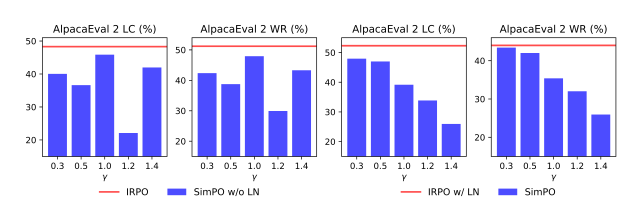
The margin-sensitivity experiment compares a fixed SimPO margin against IRPO’s learned response-specific adjustment. Figure 1 lets readers see how the win-rate comparisons change as the fixed margin is varied. The experiment speaks to the cost of tuning one global choice. The discriminator shifts some of that work into an extra training stage.
Keep an eye on the trade-off across tasks
The experiments compare methods with different numbers of hyperparameters and different requirements for reference-model scores. They also compare instruction following and reasoning settings. A practical result has to be read across that set of conditions. The theoretical objective gives a reason to prefer a particular way of using the examples. The benchmark comparisons show where that reason does or does not translate into a measurable gain.
The downstream check puts the cost in concrete terms. In Table 2, the base model scores 78.1 on GSM8K, while DPO scores 51.2, SimPO 56.6, and IRPO 54.6. On MMLU-Redux the corresponding numbers are 62.4, 58.1, 54.6, and 60.1. The same IRPO run therefore preserves more of one capability and loses ground on another. These scores are from one continued-training setting, and the losses are evidence to examine alongside the preference wins.
Questions & Answers
The opening answers are simulated author responses based on the paper.
Q: Do I need to know which model wrote each answer?
A: The algorithm trains its discriminator on preferred and rejected examples. The two distributions describe where those answers come from statistically, and the ratio is estimated without querying their original generators.
Q: Why does a discriminator’s probability estimate matter more than its classification accuracy?
A: Equation 9 uses the odds, which can change sharply near zero and one. Two classifiers with the same accuracy can therefore supply very different margins. Calibration, overlap between the classes, and performance on held-out prompts are useful diagnostics.
Q: Can I compare the numbers in the table directly with human acceptance rates?
A: These results measure an automated judge on specific benchmark prompts. To estimate acceptance in a product, use representative prompts, blinded human ratings, and separate checks for facts, answer length, and failure modes that matter to the intended users.
Q: When can a learned preference margin send training in the wrong direction?
A: If preferred answers are consistently longer or more polished, the discriminator can learn those cues even when the factual procedure is wrong. Pairs that are nearly indistinguishable can create a different problem by giving the discriminator too little signal. Calibrate on held-out pairs, check whether the learned margin tracks the strength of blinded human preferences, and inspect whether that relationship changes with answer length and source.
Future Ideas
An alignment test for answers with the same style
Create a small preference set for technical support in which the answer pairs are matched on length and tone, and one answer differs in a documented troubleshooting step. Keep product families disjoint between training and evaluation. Train DPO, SimPO, and IRPO under the same total compute budget, then check whether the discriminator distinguishes correct procedures when all the style cues are similar. Use a separate slice where reviewers disagree about the best answer. Advance only if blinded reviewers find fewer material procedure errors and the system preserves its scores on a separate general-capability set.
Measure discriminator calibration and margin ordering on held-out product families before evaluating trained models. Report the results separately for strongly agreed preferences and cases with ambiguous labels.
Sources
Original abstract
Training complexity often scales with the size of hyperparameter space for Large Language Models (LLMs). While Direct Preference Optimization (DPO) offers learning stability through reparameterizing the reward function, its regularization against the reference policy can lead to suboptimal outcomes when the reference policy is not optimal. Recent DPO variants address this concern, but at a cost: they introduce additional hyperparameters, reducing feasibility for LLM fine-tuning. To overcome this challenge, we introduce Implicit policy Regularized Preference Optimization (IRPO), which tackles suboptimality while maintaining training simplicity. By treating the winning policy that generated the chosen responses in a pairwise dataset as an implicit policy, IRPO maximizes KL-regularized reward without extra hyperparameters. Then we propose a novel PO algorithm that directly optimizes the IRPO objective by estimating the likelihood ratio between implicit policies. As the winning policy generally outperforms the reference policy, IRPO can effectively address suboptimality. Our experiments show that IRPO significantly outperforms baseline algorithms with the same hyperparameter complexity. Moreover, IRPO demonstrates comparable performance to recent algorithms that rely on a larger number of hyperparameters, offering a practical solution for scalable LLM fine-tuning.