Overview
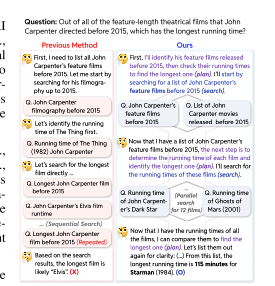
Some search queries can run in parallel. If you want to compare three public reports, you can look for each immediately. But if the question asks for the birthplace of a person identified only through clues, you must find the name first. Moontae and his colleagues train a search agent to handle questions that mix those two patterns. The agent learns to issue groups of queries, synthesize the results, and decide what to search next.
Key Findings
A reporter gathering clues about an unfamiliar place can check several facts in parallel. The next question may have to wait until those facts identify the place. The search agent in this paper learns to switch between those two rhythms.
Teach the agent to change gears
HDS-QA builds hybrid questions from existing single-hop questions. The construction process starts with an entity, retrieves material about several distinct characteristics, and asks a model to combine those characteristics into clues that identify the entity. Replacing the named entity in the seed question with the clues produces a question with an additional dependent step.
The training examples include the intermediate reasoning, queries, retrieved evidence, and answer. At inference time the model can generate one query or a batch. An external model summarizes results separately for each query. The agent then reads the combined evidence and can start another turn. This lets it search for independent clues together and use what it learns to decide which dependent queries are useful. Dataset and query format
Breadth and depth help in different places
| System | FanOutQA F1 | FanOutQA average turns | FRAMES F1 | BrowseComp subset F1 |
|---|---|---|---|---|
| Search-o1 | 26.7 | 5.2 | 34.2 | 4.5 |
| DeepResearcher | 26.4 | 3.6 | 28.5 | 4.5 |
| RAG-R1 | 28.2 | 1.9 | 35.8 | 5.9 |
| HybridDeepSearcher | 44.1 | 3.1 | 39.1 | 15.1 |
F1 measures word overlap with the reference answer. A search turn can contain several calls, so the number of turns and the number of API requests are separate budgets. The BrowseComp result applies to the 150-question subset that OpenAI o3 solved within a five-minute web search limit. The main hybrid model and Search-o1 use Qwen3-8B. Other iterative search baselines use Qwen2.5-7B-Instruct. The paper also trains a matched Qwen2.5-7B-Instruct version, which scores 8.4 F1 on the subset compared with 15.1 for the Qwen3-8B version. In Table 4, a version trained to issue a single query per turn on the same underlying questions scores below the hybrid model on all five benchmarks by the reported judge accuracy. That comparison isolates training for search behavior more directly than the comparison across independently trained baselines. Table 2 and efficiency curves · Single-query ablation
Different budgets invite different searches
The call-limit comparison varies two resources separately. On the BrowseComp subset, the study tries maximum turn counts of 1, 2, 4, and 8, and maximum call counts of 2, 4, 8, and 16. The plots use actual average usage on the horizontal axis. A model that answers early may consume less than the maximum. Search turns are a proxy for latency, since parallel calls can finish in one turn. A larger batch lets the model pursue complementary clues without waiting on every result. Sequential rounds still give it a place to reconcile conflicting clues and formulate the next query. The experiment tracks whether the extra work translates into better answers.
Check whether it actually found the evidence
The researchers also test search coverage separately from answer accuracy. They use the Wikimedia API to retrieve results for the model’s queries and compare the union of returned links, , with the benchmark’s annotated evidence links, . The reported mean coverage for question set is
This measures how much annotated evidence the queries recover. It leaves the next step open. The search agent still has to read the evidence and produce the right answer. See the annotated-evidence test in Table 3.
Take away the parallel option
The ablation compares the hybrid model with a single-query version. That gives the model a chance to show what batching contributes beyond the training data and the ability to search in several rounds. It also matters how good the external summarizer and retriever are. A carefully structured batch can only bring back evidence the search service can surface, and the model still has to combine those summaries accurately.
Questions & Answers
The opening answers are simulated author responses based on the paper.
Q: Can the agent launch every query at once?
A: Some queries depend on facts discovered later. We let the model use multiple queries in a turn when it can and issue follow-up queries after it has seen the results.
Q: Why count search turns and API calls separately?
A: Each turn waits on a set of searches and the next reasoning step. Parallel searches can lower the depth of a run, but each query still consumes a request. We plot performance against both budgets.
Q: Does the hybrid model improve with reinforcement learning?
A: The reinforcement-learning variant raises judge accuracy in the reported comparison while taking more turns on average. Its area under the accuracy–turn curve is lower on four benchmarks and tied on FanOutQA, so the supervised model remains a useful comparison when latency matters.
Q: How can we tell whether a gain came from planning more useful searches or from the summarizer?
A: The external summarizer is part of the tested system. It may surface the fact the next query needs, or omit it. The matched Qwen2.5 comparison helps isolate the search setup, while the larger BrowseComp result includes a different model configuration and a selected task subset. A replay that holds the search results fixed and varies the summarizer can help attribute downstream errors.
Future Ideas
Let an investigation show which answers are waiting on evidence
In an engineering incident assistant, label each query with the fact it is meant to establish and any prior finding it needs. Run independent searches in parallel across logs, release records, and service documents. Keep a short dependency list so a follow-up query is triggered only when its prerequisite is supported by a retrieved source.
Test on completed incidents with held-out services and frozen copies of their evidence. Compare the trained hybrid agent with sequential search and a fixed fan-out policy. Measure supported root-cause identification at equal request budgets, and measure elapsed time under the same API concurrency limits. Count missing or contradictory citations as well as correct summaries.
Separately count whether the source returned evidence for each prerequisite and whether the summarized result preserved it. Use frozen logs for the main comparison so differences in indexing cannot explain the gain.
Sources
Original abstract
Large reasoning models (LRMs) combined with retrieval-augmented generation (RAG) have enabled deep research agents capable of multi-step reasoning with external knowledge re- trieval. However, we find that existing approaches rarely demonstratetest-time search scal- ing. Methods that extend reasoning through single-query sequential search suffer from lim- ited evidence coverage, while approaches that generate multiple independent queries per step often lack structured aggregation, hindering deeper sequential reasoning. We propose ahy- bridsearch strategy to address these limitations. We introduceHybridDeepSearcher, a structured search agent that integrates parallel query expansion with explicit evidence ag- gregation before advancing to deeper sequential reasoning. To supervise this behavior, we introduceHDS-QA, a novel dataset that guides models to combine broad parallel search with structured aggregation through supervised reasoning–query–retrieval trajectories containing parallel sub-queries. Across five benchmarks, HybridDeepSearcher significantly outperforms the state-of-the-art, improving F1 scores by +15.9 on FanOutQA and +9.2 on BrowseComp†. Further analysis shows its consistent test-time search scaling: performance improves as ad- ditional search turns or calls are allowed, while competing methods plateau.