Overview
A query can sound simple while its answer depends on a source that uses different words. The opening example in the paper asks whether water collected under a plant pot can be reused. The relevant source explains why reusing that runoff can be harmful, even though it barely resembles the original question. REPAIR gives the search system a way to look for that missing connection as it reranks its results.
Key Findings
The missing document in a simple gardening question
The paper opens with a gardening question. After watering, water collects in the plates under the pots, and the asker wants to know whether reusing it is fine. A similarity search latches onto words like "reuse plant water." The document that actually settles the matter has to bridge from the premise (runoff collects) to the conclusion (reusing it is harmful), and it often looks nothing like the query (Section 1). The authors call such sources bridge documents. Retrievers rank them low.
Reasoning-based rerankers try to lift them. A reranker reads a window of candidates, writes out a reasoning trace, and orders the window to match. Figure 1(a) shows this loop, with the planning step drawn as a black box.
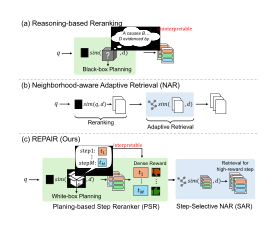
Because it only reorders a fixed pool, a bridge document that the first-stage retriever never returned stays lost. The authors call this bounded recall (Section 2.2).
More candidates can pull a search off course
Neighborhood-aware adaptive retrieval (NAR) attacks bounded recall. After each reranking window, it looks up the neighbors of the top-k documents in a precomputed corpus graph and folds them into the next window (Section 2.3, Eq. 2). Figure 1(b) shows this. The expansion follows whatever currently ranks highest, so a window biased toward a weak reasoning direction pulls in more of the same. The reranker's reasoning stays unstructured and gets discarded after ranking, so the expansion step cannot tell which part of the plan is under-supported (Section 2.4).
The experiments confirm the worry. Table 4 pairs existing rerankers with NAR and finds that precision falls.
| Reranker | nDCG@10 without NAR | nDCG@10 with NAR |
|---|---|---|
| RankZephyr-7B | 13.1 | 9.8 (-3.3) |
| REARANK-7B | 19.1 | 13.3 (-5.8) |
| REPAIR-7B | 20.2 | 24.7 (+4.5) |
Table 4 reports these BRIGHT results. REPAIR without NAR corresponds to the planning-based reranker, or PSR.
Recall tells the same story. In Figure 3, RankZephyr and REARANK with NAR reach Recall@100 of 36.7 and 37.5, both below the 38.9 of the initial BM25 list. REPAIR reaches 45.3 (+6.4).
A search plan that exposes its own gaps
REPAIR has three modules. The planning-based step reranker (PSR) is a Qwen-2.5-7B-Instruct model fine-tuned on 72k MS MARCO queries, with training data generated by DeepSeek-R1. For each window it emits a numbered list of reasoning steps and a reranked document list in one pass (Section 3.1, Eq. 3). The authors describe it as a deliberately simplified interface that reproduces the planning behavior of existing rerankers while keeping the steps readable. Appendix D.6 shows that Rank-R1 and ReasonRank already write planning-like text before ranking.
The second module scores the steps. The baseline reward favors steps that the current top documents cover poorly:
Here is a plan step, is the reranked window, is Contriever embedding similarity, and is the sigmoid (Eq. 4). High similarity to the top documents drives the reward down. The authors warn that this signal treats steps in isolation and can over-prioritize minor ones.
The consistency reward adds memory. Successive windows imply pairwise preferences between documents. The paper aggregates them with a Bradley–Terry model:
where reflects how often was ranked above in past iterations (Eq. 5). For step , let be the document pairs ordered by a ranking that uses only that step. Its reward is the average agreement with the consensus:
(Eq. 7). A low value flags a step whose ordering contradicts earlier windows. The final reward combines the two through a function , implemented as a plain sum (Eq. 8 and its footnote). The scores reuse the plan from the same model call that produced the ranking. A window with steps yields reward signals without another language-model generation call.
The third module, step-adaptive NAR (SAR), picks the step with the highest reward and builds the next window from the top-k documents plus neighbors ranked by similarity to that step (Section 3.3, Eqs. 9–10 and Algorithm 1). The settings are window size b = 20, k = 10, and 16 neighbors per document. Expansion runs only in the latter half of the iterations, which matches the retrieval frequency of standard NAR and lets the preference model gather history first.
Better evidence can lead to a better answer
Table 1 reports nDCG@10 for reranking the top 100 BM25 results on BRIGHT's 12 subsets. Selected averages follow.
| Method | Average nDCG@10 |
|---|---|
| BM25 (initial retrieval) | 14.5 |
| SUNARR | 10.1 |
| RankZephyr-7B | 13.1 |
| Rank-R1-7B | 17.9 |
| REARANK-7B | 19.1 |
| QwenRerank-7B (zero-shot) | 21.2 |
| REPAIR-7B (knowledge-intensive training data) | 24.7 |
| ReasonRank-7B (reasoning-intensive training data) | 26.5 |
| REPAIR-7B (reasoning-intensive training data) | 28.3 |
Table 1 reports nDCG@10 on a 0–100 scale. The metric rewards finding relevant documents near the top of the list.
The paper states a 10.2-point gain over BM25 and a 5.6-point gain over REARANK, which it calls the best-performing baseline among the models trained on knowledge-intensive data. The zero-shot QwenRerank-7B row scores 21.2 in the same table. The authors set aside the ReasonRank comparison for the main analysis because its training data may overlap with BRIGHT. Appendix D.5 reports that 276 of ReasonRank's 148,107 training documents match BRIGHT gold documents.
On HotpotQA, 2WIKI and MuSiQue (500 sampled queries each), Table 2 shows REPAIR leading every EM and F1 column, for example 15.4 F1 on MuSiQue against 13.1 for RankZephyr. Appendix tables repeat the pattern with ReasonIR and Qwen3-Embedding first stages.
Earlier rankings keep the next search on track
Table 5 removes reward components.
| Variant | nDCG@10 | Recall@100 |
|---|---|---|
| REPAIR-7B | 24.7 | 45.3 |
| without base reward | 24.3 | 44.8 |
| without consistency reward | 23.6 | 43.6 |
| without both | 20.2 | 38.9 |
Table 5 reports these component-removal tests on BRIGHT.
Each reward contributes, and dropping both costs the most. Figure 2 (page 7) tracks Recall@20 across iterations. Standard NAR on top of PSR fluctuates and often falls below BM25. The authors attribute this to semantic shift, where expansion drifts away from the original query. SAR improves steadily. Figure 4 varies how many iterations feed the Bradley–Terry model. It overtakes the no-BT variant around three to four iterations. The implementation waits for the latter half of the search before expanding, giving the consistency model rankings to compare.
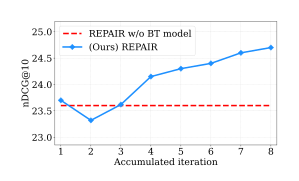
Table 3 checks the planning interface by itself. PSR scores 20.2 against 19.1 for REARANK. SUNARR reaches 10.1, or 11.0 when given the same plan R. Appendix D.3 adds two case studies. For the mental-fatigue query, the baseline without rewards expanded around a step that categorized types of fatigue, and the gold document stayed beyond rank 100. REPAIR picked the step about physiological mechanisms and ranked the gold document first.
Where the savings come from
Table 6 shows PSR generating 1803.2 tokens per query against 7088.2 for REARANK-7B and 2622.0 for Rank-R1-7B. Reusing one plan across all windows cuts this to 550.7 tokens at 23.8 nDCG@10. SAR adds little compute per window, at 191.6 TFLOPS against 188.0 for PSR alone (Table 7). Appendix D.4 puts one full query at 1724.4 TFLOPs for REPAIR and 1893.6 for SUNARR. A 3B version reaches 17.7 nDCG@10 against 14.0 for Rank-R1-3B (Table 9).
The paper lists its own limits (Section 6). REPAIR relies on its purpose-built planner, and other rerankers emit differently formatted traces that would need conversion. Weak initial plans can still steer retrieval, and each window uses a fixed plan. Results come from single runs, and the QA experiments use 500-query samples that Appendix C checks on 2WIKI, where F1 differs by under one point from the full set.
Questions & Answers
The opening answers are simulated author responses based on the paper.
Q: What makes a source a bridge?
A: It helps connect the question to the answer through an intermediate concept. In the plant example, the evidence explains the effects of reusing runoff. It becomes useful once the search plan connects runoff to the decision about reuse.
Q: Why expand for one step?
A: Expanding around every step can spend effort on incidental details and add distracting documents. The method scores the steps and directs expansion to a high-scoring one, combining incomplete coverage with evidence from earlier rankings.
Q: Does the consistency signal protect against a wrong plan?
A: It can penalize steps that conflict with earlier ranking preferences, and those preferences can also be wrong. A credible application should check retrieved evidence against the question and allow the system to stop or escalate when critical information is unsupported.
Q: What would show that expansion found the evidence a question was missing?
A: Check each information requirement against independently labeled source passages and see whether the expanded set adds a passage the first pass lacked. An answer score alone cannot identify that change. The result also depends on which documents enter the first-stage pool and how the graph connects them. The reported single runs leave uncertainty about small differences.
Future Ideas
Recover missing dependencies in engineering incident search
During an incident, a question about a symptom may require linking a recent deployment to an undocumented service dependency and then finding the owner’s runbook. Start with read-only search over the affected team’s permitted incident logs, service inventory, and runbooks. Let the system pursue one poorly supported step and surface the new source alongside the original candidate set for a human operator.
Evaluate on closed incidents with annotated evidence paths. Compare the approach with fixed reranking, an extra generic search at the same latency budget, and graph expansion without the step score. Measure whether it finds independently annotated bridge documents, the fraction of queries in which the added results are distractions, and time to locate actionable evidence.
Separate cases where a bridge is present in the first-stage pool from cases where it can only enter by expansion. For each, measure whether the final answer used the newly found evidence using source citations checked against the annotated path.
Sources
Original abstract
We study leveraging adaptive retrieval to ensure sufficient “bridge” documents are retrieved for reasoning-intensive retrieval. Bridge documents are those that contribute to the reasoning process yet are not directly relevant to the initial query. While existing reasoning-based reranker pipelines attempt to surface these documents in ranking, they suffer from bounded recall. Naive solution with adaptive retrieval into these pipelines often leads to planning error propagation. To address this, we propose REPAIR, a framework that bridges this gap by repurposing reasoning plans as dense feedback signals for adaptive retrieval. Our key distinction is enabling mid-course correction during reranking through selective adaptive retrieval, retrieving documents that support the pivotal plan. Experimental results on reasoning-intensive retrieval and complex QA tasks demonstrate that our method outperforms existing baselines by 5.6%pt.