Overview
A collection of research articles might contain recognizable topics such as reinforcement learning and statistics. Those topics also intersect. This paper asks how to learn the themes and their relationships from a single set of co-occurrence counts, then use the relationships to organize a large collection.
Key Findings
The newspaper archive needs an index for its index
Five topics can orient a reader in a technical archive. Twenty-five can separate narrower research communities. In the workshop’s conference-paper collection, a single five-topic fit puts mathematical learning theory and probabilistic modeling under one heading. Fitting 25 subtopics before grouping them into five separates that pair. The same archive can support a different organization when the model learns which narrower subjects occur together.
Make the co-occurrence matrix fit the problem
The input is a matrix of pairs of things observed together. In documents, those are words in the same text. In music playlists, they are tracks appearing on the same list. The factorization assigns objects to topic distributions, then records how often topics occur together. It describes each pair of words through both their topics and the relationship between those topics.
Real counts can yield a noisy matrix whose mathematical properties disagree with the ideal model. The Rectified Anchor Word algorithm projects the empirical matrix toward a low-rank, positive semidefinite, nonnegative, normalized version before selecting anchor words. Under the model, an anchor belongs to just one topic. Its row gives a reference distribution that can help explain the observed rows of other words.
The workshop uses sparse implicit column-pivoted QR to find those reference words without explicitly projecting every other row at every step. For a vocabulary of size and topics, the algorithm stores the basis in space and performs updates in time, where counts the nonzero entries in the input matrix. An ADMM solver with Douglas–Rachford splitting recovers topic mixtures under nonnegativity and unit-sum constraints. The two changes address different costs. One changes how anchors are found, and the other changes how the chosen anchors are used to fit the model. Algorithms 2 and 3
Ask the topics who their neighbors are
Once the model learns 25 subtopics, it has a new co-occurrence matrix to study. That matrix records topic pairs instead of word pairs. The first line below is the paper’s factorization at level , where is the observed matrix for that level, connects it to its topics, and describes those topics’ correlations. The second line describes the input at the next level.
This works because has the same structural properties as the ideal . Meaningful off-diagonal entries matter. A matrix that put each topic entirely on its own would give the next level little evidence about shared themes. The hierarchy can give a subtopic weights in multiple broader topics, producing a directed acyclic graph across levels.
A different split from the same corpus
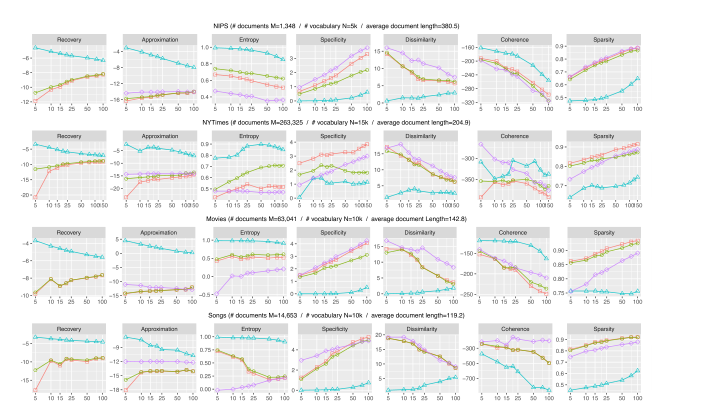
The paper compares four collections, including technical papers, New York Times articles, movie ratings, and playlists. The experiments compare two rectified spectral solvers against the unrectified spectral baseline and Gibbs sampling. The unrectified baseline fell behind the other methods across much of Figure 1. In the same comparison, ADMM-DR tended to recover more concentrated topics and reduced reconstruction and approximation errors relative to exponentiated gradient, especially when the number of topics was small. The anchor routine preserved the choices made by explicit pivoting. The ADMM recovery step took longer than the exponentiated-gradient step when the authors used the same 500-iteration cap. Main experiments
In the conference-paper collection, the clearest evidence for the hierarchy is qualitative. These selected rows from Table 1 show the words associated with each topic as printed in the paper.
| Fit | Topic | Top words |
|---|---|---|
| Recursive fit, 25 to 5 | T3 | bound, threshold, theorem, class, dimension, polynomial, proof |
| Recursive fit, 25 to 5 | T4 | gaussian, density, likelihood, noise, mixture, component, prior |
| Direct JSMF fit at 5 | T4 | gaussian, noise, hidden, approximation, matrix, bound, examples |
| Direct LDA fit at 5 (Gibbs) | T4 | gaussian, approximation, matrix, bound, component, variables |
Let the playlists test a different kind of structure
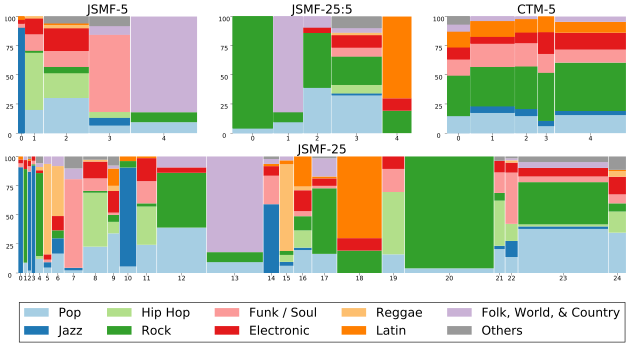
The song collection has genre labels that make an otherwise subjective comparison more legible. A direct five-topic fit isolates Jazz, Funk, and Folk. With 25 topics, distinct Reggae, Latin, and Rock clusters also appear. Grouping those 25 topics into five yields broader topics dominated by Rock and Latin. The correlated topic model run with its default settings yields less distinguishable genre associations in this comparison.
Figure 2 uses two scales. A bar’s height gives the genre composition of its 20 highest-ranked songs, while its width gives the estimated prevalence of that topic across the corpus. If the topic-pair probability matrix is , the width for topic is proportional to the marginal probability
That distinction helps explain how the flat fit could isolate Jazz and Funk while the recursive fit isolated Rock and Latin. A distinctive topic can still be comparatively rare. Playlist analysis
Questions & Answers
The opening answers are simulated author responses based on the paper.
Q: What is an anchor word?
A: Under the separability assumption, an anchor word occurs in only one topic. Its co-occurrence pattern supplies a vertex of the model, and the patterns of other words are represented as convex combinations of those vertices.
Q: What does a topic connection mean?
A: It summarizes how topics occur together in the data. It can help organize a collection, while a reader may give the connection a more specific interpretation.
Q: Would a different choice of anchors change the hierarchy?
A: It could. The paper illustrates how a hierarchy can change with the way topics are recovered. In the playlist example, the recursive run finds Rock and Latin where the direct run finds Jazz and Funk. The authors suggest that the prevalence of those genres may help explain the difference. These examples illustrate how the procedures behave on the collection. Stability calls for repeated fits with different anchors and topic counts.
Future Ideas
Test a hierarchy against the task of finding a paper
Build topic maps for a fixed archive with flat spectral topics, recursive topics, and a text-search baseline. Ask readers to find papers answering cross-topic questions. Compare successful searches against independent relevance judgments. Measure time to discovery and group stability across topic counts, anchor choices, and the addition of a new year of papers.
Repeat the same discovery test across several anchor selections and sizes of the topic vocabulary. Check whether useful paths to the same papers survive changes in the group labels.