Overview
An image detector can compare a picture with its reconstruction by a diffusion model’s autoencoder. A smooth background may dominate that comparison even when the details distinguish a photograph from a generated image. HFI uses a filtered copy to estimate and subtract a shared part of the reconstruction signal.
Key Findings
A generated picture can be so easy for its own model to reconstruct that a detector treats that familiarity as a clue. The problem is that a simple reconstruction distance can also respond to texture and resizing. HFI uses a second version of the same image to find out how much of the distance depends on fine detail.
Compare the original with its low-frequency counterpart
The autoencoder compresses and reconstructs an image . The filter suppresses fine detail. The authors define HFI through a directional derivative, then use a first-order approximation in Equation 3:
The distance compares images in a perceptual feature space. Subtracting the second distance asks how much additional reconstruction error appears when the fine detail is present. Figure 2 shows both a real image with delicate details that the autoencoder changes and the score distributions on a toy test.
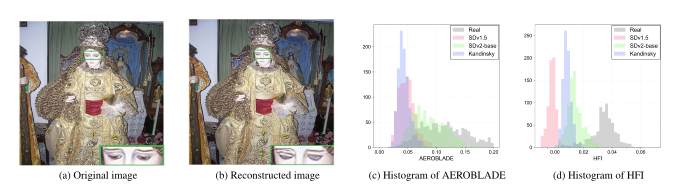
Table 1 reports selected mean GenImage scores in the cross-autoencoder comparison. Each value is AUROC, which measures ranking across thresholds. These rows use the second-layer perceptual distance in both methods.
| Autoencoder | AEROBLADE LPIPS2 | HFI LPIPS2 |
|---|---|---|
| Stable Diffusion v1.4 | 0.928 | 0.959 |
| Stable Diffusion v2-base | 0.873 | 0.923 |
| Kandinsky | 0.810 | 0.880 |
| MiniSD | 0.882 | 0.930 |
Section 5 also tests whether an image can be traced to SDv1.5, SDv2-base, or Kandinsky among a four-generator candidate pool. SDv2.1 appears only as a non-belonging generator in the attribution table. The signal comes from the autoencoder’s behavior, so the paper describes this as implicit watermarking. The result does not authenticate an image or establish ownership on its own.
A filtered copy acts as a control
The comparison keeps the underlying subject mostly in place while suppressing high-frequency information. If the distance changes, the two inputs give evidence about what the reconstruction method was responding to. The study compares different autoencoders and perceptual layers. Those choices matter because the reconstructed image is only one input to the score. The representation used to compare it with the original can affect what gets measured.
Detection and attribution have different questions
One experiment tries to separate real from generated images. The attribution experiment asks whether a specific latent diffusion generator produced a given image among the listed alternatives. The latter resembles checking an implicit signature that emerges from the generator. It does not require the producer to embed a separate watermark. The paper compares the attribution score and runtime with a baseline that uses optimization. A fixed candidate pool leaves open what happens when the true generator is absent.
Questions & Answers
The opening answers are simulated author responses based on the paper.
Q: What does training-free mean here?
A: The score uses an already trained autoencoder and perceptual features. It avoids fitting a separate detector on labeled real and generated images.
Q: Can it identify any unknown generator?
A: The tracing experiment compares known candidates. It does not establish open-world identification.
Q: Where is the provenance claim narrower than the detection claim?
A: Flagging possible synthesis and attributing an image to a particular generator are distinct decisions. The tracing experiment compares clean outputs from a known pool, and the paper reports weaker performance under severe JPEG compression or cropping. An editorial test should count mistaken attribution of real photos and unseen generators and report false alerts at a practical review threshold.
Future Ideas
Show attribution uncertainty in an image review tool
Compare a submitted image with several known autoencoders. If the signals are close or all weak, leave attribution open. Test resizing, compression, and generators absent from the candidate list. Score false attribution and abstention separately before using any result in an editorial decision.
Reserve whole generator families and camera sources for evaluation. Set separate operating thresholds for suspected synthesis and likely attribution, and report confidence at the low false-alarm rates the reviewer can handle.
Sources
Original abstract
Dramatic advances in the quality of the latent diffusion models (LDMs) also led to the malicious use of AI-generated images. While current AI-generated image detection methods assume the availability of real/AI-generated images for training, this is practically limited given the vast expressibility of LDMs. This motivates the training-free detection setup where no related data are available in advance. The existing LDM-generated image detection method assumes that images generated by LDM are easier to reconstruct using an autoencoder than real images. However, we observe that this reconstruction distance is overfitted to background information, leading the current method to underperform in detecting images with simple backgrounds. To address this, we propose a novel method called HFI. Specifically, by viewing the autoencoder of LDM as a downsampling-upsampling kernel, HFI measures the extent of aliasing, a distortion of high-frequency information that appears in the reconstructed image. HFI is training-free, efficient, and consistently outperforms other training-free methods in detecting challenging images generated by various generative models. We also show that HFI can successfully detect the images generated from the specified LDM as a means of implicit watermarking. HFI outperforms the best baseline method while achieving magnitudes of