Overview
A photo of a vase against a blank wall can be easy for an image model to reconstruct. So can an image produced by a generative model. A detector that equates easy reconstruction with AI generation can confuse the two. This study tries a different test. It checks how reconstruction changes when the same image is blurred or rotated, and combines that signal with another measured inside the model.
Key Findings
The smooth wall that fooled a detector
A photograph of a dog against an empty wall is easy to reconstruct. That sounds like a virtue for an image model. For an image detector built around reconstruction error, it can be a problem. The detector gives a synthetic image a higher suspicion score when the image passes too easily through the autoencoder, the component of a latent diffusion model that compresses and reconstructs pictures. Familiar structures in generated images can produce a small difference between the input and the reconstruction. A real photograph with a simple background can yield the same signal for a different reason.
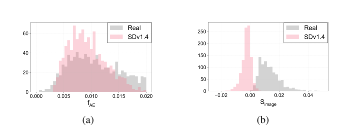
The authors tested this explanation by using a segmentation model to isolate objects in real photographs and replacing their surroundings with black. The subjects remained recognizable, but the reconstruction errors of the altered photographs moved into the range seen in Stable Diffusion v1.4 outputs. In the paper's Figure 3, the distributions overlap substantially before correction. The second panel shows that the authors' image-level score separates them more clearly on this controlled example.
What changes when a picture is turned on its side
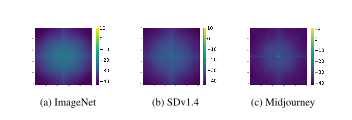
The paper looks for a better comparison by transforming the very image that the detector is evaluating. Figure 4 shows the average frequency spectrum of the reconstruction residual, the difference between an image and its reconstruction. In this analysis, real ImageNet pictures leave more high-frequency residual energy than samples from Stable Diffusion v1.4 and Midjourney. A low-pass filter removes fine-scale content while retaining much of the broad background structure. Rotation gives the detector a separate comparison. In the rotated analysis in Figure 5, distortions in the reconstruction of the synthetic images become more pronounced relative to those in the real images.
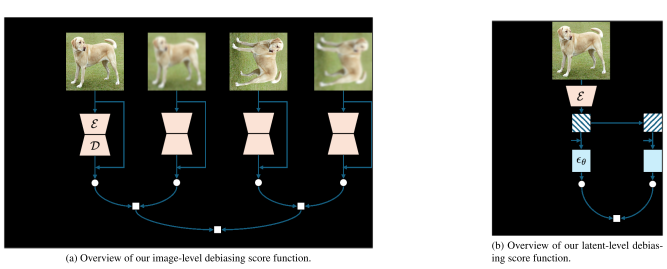
In the paper's Equation 4, the authors first compare reconstruction errors on the upright and rotated image, then repeat the comparison on low-pass-filtered copies. Here measures reconstruction error, is the low-pass filter, is a 90-degree rotation, and weights the rotation.
This calculation gives each picture its own control. A smooth background contributes across several views, while the way fine details respond to filtering and rotation can make the original detector's evidence more informative.
The second test happens inside the model
An autoencoder trained as part of Stable Diffusion has a particular relationship to pictures made by latent diffusion systems. It need not reconstruct pictures from other kinds of generators especially well. The authors therefore add a separate test in the model's latent space, where a compressed representation stands in for the image. They add Gaussian noise to the representation and measure how far the model's noise prediction is from the noise they added. This noise-prediction error helps distinguish real bedrooms from ProGAN bedrooms, but it also depends on the size of the latent vector. In the Figure 6 scatter plot, larger norms are associated with smaller errors in both groups.
Their control rotates the latent representation while preserving its norm. Comparing the two noise-prediction errors helps account for that dependence. Equation 7 joins the image and latent scores. Here encodes the image as a latent, and is the rotation-based comparison of noise-prediction errors from Equation 6.
Two benchmarks make the reason for two scores clear
GenImage largely compares real ImageNet images with outputs of text-to-image generators. LSUN-Bedroom compares real bedrooms with outputs from a mix that includes GANs and image diffusion models. The image branch is strongest on the first benchmark. The latent branch carries the second. The combined detector achieves the highest mean AUROC among the compared methods in Tables 1 and 2. AUROC measures how well the score ranks generated examples against real examples across possible thresholds.
| Score, Table 3 | GenImage AUROC | LSUN-Bedroom AUROC |
|---|---|---|
| Raw autoencoder error | 0.902 | 0.476 |
| Raw latent error | 0.408 | 0.666 |
| Debiased image score | 0.969 | 0.464 |
| Debiased latent score | 0.667 | 0.963 |
| Combined RDD | 0.981 | 0.940 |
The combined score improves on both individual scores on GenImage. On LSUN-Bedroom, the latent score alone is higher. Table 4 tests other combinations and shows the balance depends on how the two scores are weighted. The score also remained competitive with the compared detectors when the authors applied JPEG compression and center crops followed by resizing to LSUN-Bedroom images. Those perturbations cover two ways images change during routine sharing. Robustness experiment, Figure 9
A second use for the same signal
Detecting a synthetic image and identifying the model that made it are different tasks. To study attribution, the authors generated images from four known latent diffusion models using the same prompt set. They then used the image-level score to rank whether an image belonged to a particular model in each of nine pairwise comparisons. The score exceeded LatentTracer's AUROC in all nine reported comparisons. On one A100 GPU, the paper reports 0.292 seconds per sample for the image-level score and 14.65 seconds for LatentTracer. These comparisons are among known candidate models. An image from an unknown generator remains an open case. Attribution experiment, Table 6
Questions & Answers
The opening answers are simulated author responses based on the paper.
Q: Why might a rotated image help?
A: A rotation preserves much of the image’s content and background. In our tests it changed reconstruction behavior in ways that differed between some real and generated examples. Comparing reconstruction before and after rotation can reduce the effect of an image simply being easy to reconstruct.
Q: Does training-free mean no learned model is involved?
A: We use pretrained diffusion models. Training-free refers to fitting the detector. It does not require labeled real and generated examples to train a classifier.
Q: Is a high RDD score proof of an image’s origin?
A: A score is evidence about reconstruction behavior. It does not identify the creator or reconstruct the file’s history. For individual cases, metadata, original files, and provenance records answer questions that the detector cannot.
Q: How would an image desk choose a score threshold?
A: An AUROC summarizes ranking across many thresholds. A desk with limited staff needs to know which images will be flagged at the threshold it can actually use. Measure false flags separately for untouched photos, heavily edited photos, and different backgrounds. Include runtime too. The paper’s timing for the image score alone does not include the whole combined decision.
Future Ideas
A provenance queue that treats smooth backgrounds as a test case
Build a reviewer tool that shows the raw reconstruction score, the debiased score, and a note when they diverge. Start with a controlled collection of real catalog photos and generated substitutes. Include plain backdrops, product cutouts, recompression, and editorial crops. Compare RDD and raw reconstruction as ranking tools under the same number of manual reviews.
Track generated examples found, genuine photos flagged, processing time, and how those figures change across backdrop types and file transformations. Keep generator families and photography sessions separated between tuning and evaluation. Use the result to decide whether the detector helps select cases for a provenance check.
Freeze an alert threshold on a separate validation split, then report false alerts and recall on untouched and processed photographs and generated images at that threshold. Record time for both score paths on the equipment the desk would actually use.