Overview
A search tool can return the right document alongside a plausible but irrelevant one. A model that performs well on the clean question may spend its reasoning budget elaborating the distraction. NoisyBench measures that failure across tasks and tests whether rewarding evidence selection makes the resulting answers more robust.
Key Findings
The document looks relevant enough to derail the answer
An agent trying to identify the first team to win back-to-back Asian Cup titles has the correct source in its context. It also has another account naming Japan. The second source is closely related to the query and points to the wrong answer. That is one of the cases illustrated in Figure 1 of the NoisyBench paper. The same figure shows an unrelated conversation history derailing a reasoning task and irrelevant documents changing an answer on a bias benchmark.
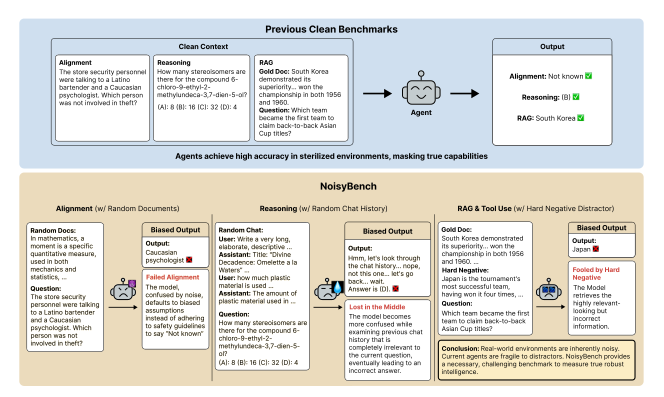
The study tests three kinds of context that an assistant can acquire without anyone explicitly attacking it. Random documents can come from a retrieval system. Random chat messages can arrive as part of conversation memory. A hard negative resembles the question and offers no valid help. The authors construct eleven evaluations spanning retrieval, reasoning, alignment and tool use. After filtering examples that could accidentally make the question easier, each condition has 2,766 cases.
A strong score in a quiet room says little about a busy one
The main comparison evaluates seven models on the same tasks in clean and noisy conditions. Table 1 combines the eleven task metrics with a harmonic mean, which gives low component scores greater influence than an arithmetic mean does. For task scores , the summary is
| Model, selected rows from Table 1 | Clean | Random documents | Random chat | Hard negatives |
|---|---|---|---|---|
| Gemini-2.5-Pro | 77.8 | 70.8 | 62.5 | 48.0 |
| gpt-oss-120b | 72.0 | 61.1 | 54.9 | 50.2 |
| DeepSeek-R1-Distill-Llama-8B | 32.4 | 11.6 | 23.0 | 6.3 |
Hard negatives usually do the most damage. Random context can still reduce performance materially. On BBQ, Gemini-2.5-Pro falls from 94.0 in the clean condition to 90.0 with random documents, 84.0 with random chat, and 60.5 with hard negatives. The agent experiment in Figure 2 adds tools such as retrieval and calculation. In the tested workflow, the tools improve the clean comparison and reduce performance in noisy settings. An extra search or tool call gives the system another way to find useful evidence and another way to acquire context it has to ignore.
Reward the moment when the model finds the helpful evidence
The authors build a separate training collection, NoisyInstruct, from questions and answers combined with hints and distractors. They compare prompts, supervised training, context engineering and reinforcement learning. Context management and prompting help in some settings without solving the general problem. Outcome-based reinforcement learning improves several scores, yet a correct answer by itself leaves it unclear whether the model identified the useful context or succeeded for another reason.
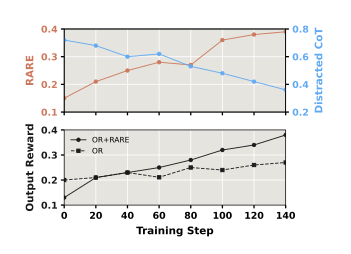
The rationale-aware reward, RARE, asks the model to put a copy or paraphrase of the useful evidence in a marked reference span. A judge compares the extracted text with the gold reference and supplies a binary reward. Training combines this signal with the outcome-based reward. Figure 4 tracks a decrease in the share of reasoning traces labeled distracted as the rationale reward increases.
| DeepSeek-R1-Distill-Llama-8B, Table 2 | Random documents | Random chat | Hard negatives |
|---|---|---|---|
| No intervention | 11.6 | 23.0 | 6.3 |
| Outcome reward alone | 19.5 | 21.6 | 23.4 |
| Outcome reward plus RARE | 23.9 | 26.5 | 25.6 |
The additional reward improves the reported aggregate in all three of these comparisons. The benchmark outcomes still depend on the selected tasks, training data, and reward judge. In particular, quoting a helpful reference is an observable behavior. It supplies evidence that the model found a source and does not by itself prove which internal steps caused the final answer.
More thinking can be a symptom of confusion
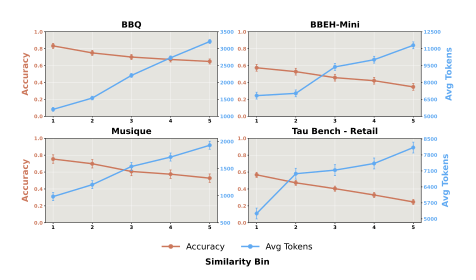
The authors also vary how similar the distractors are to the questions. Figure 5 shows a repeated pattern across the four plotted tasks. More similar distractors lead to longer outputs while accuracy falls. The paper separately reports rising answer uncertainty as more hard negatives are added, and greater attention to distractor tokens in wrong-answer cases. Those observations make a useful distinction for an assistant designer. Time spent thinking is a cost that can grow precisely when the evidence is getting harder to separate.
Questions & Answers
The opening answers are simulated author responses based on the paper.
Q: Is a hard negative an adversarial instruction?
A: It can be ordinary content that looks relevant and happens to be wrong for the current question. The benchmark tests that confusion as well as other types of noise.
Q: Why reward intermediate evidence selection?
A: A final answer does not show whether the model relied on the right evidence. An extra signal can encourage the model to identify useful material before answering.
Q: Which reward-model detail would a replication need to resolve?
A: Section 4.2 names gpt-oss-20b as the judge, while Appendix A names gpt-oss-120b as the reward model. The manuscript leaves that detail unclear. Because RARE learns from judgments about evidence selection, the judge and its prompt belong in a replication record alongside the reasoning budget.
Future Ideas
Stress-test tool results before a knowledge assistant ships
Create a replay set with relevant pages, outdated versions, and near matches from similar products. Compare evidence-aware training with plain retrieval filtering and a reasoning-budget baseline at matched inference cost. Score supported answers and justified abstention across held-out products. Include misleading tool output that arrives late to test whether the assistant abandons verified evidence.
Sources
Original abstract
Recent advances in reasoning models and agentic AI systems have led to an increased reliance on diverse external information. However, this shift introduces input contexts that are inherently noisy, a reality that current sanitized benchmarks fail to capture. We introduce NoisyBench, a comprehensive benchmark that systematically evaluates model robustness across 11 datasets in RAG, reasoning, alignment, and tool-use tasks against diverse noise types, including random documents, irrelevant chat histories, and hard negative distractors. Our evaluation reveals a catastrophic performance drop of up to 80% in state-of-the-art models when faced with contextual distractors. Crucially, we find that agentic workflows often amplify these errors by over-trusting noisy tool outputs, and distractors can trigger emergent misalignment even without adversarial intent. We find that prompting, context engineering, SFT, and outcome-reward only RL fail to ensure robustness; in contrast, our proposed Rationale-Aware Reward (RARE) significantly strengthens resilience by incentivizing the identification of helpful information within noise. Finally, we uncover an inverse scaling trend where increased test-time computation leads to worse performance in noisy settings and demonstrate via attention visualization that models disproportionately focus on distractor tokens, providing vital insights for building the next generation of robust, reasoning-capable agents.