Overview
“Exercise more” is an intention, and it still leaves a person to decide what to do first. TaskGenies turns a vague item into a few possible steps. Its workshop paper tests a practical question about planning. Can a tool supply a useful plan without making people stop and write one from scratch?
Key Findings
Give a stalled task somewhere to start
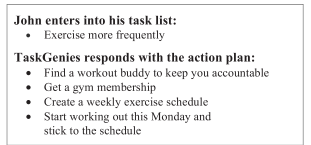
A to-do list entry says to get in shape. The workshop paper’s opening illustration turns it into actions such as arranging a gym membership and choosing a time to go. Those are examples of the smaller decisions hidden inside a broad goal. When people leave the decisions unresolved, rereading the goal can feel like taking on the whole project again. The researchers ask whether the plans that help people start can come from somewhere other than the person who owns the task.
Ask someone else to make the plan
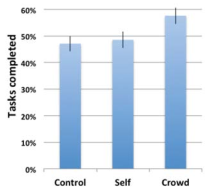
The authors compared three groups. Anonymous crowd workers made plans for one group. A second group received an explicit request to make its own plans. A control group received no planning suggestion. Asking one group to plan for itself is important because a comparison with the control alone would mix the benefit of receiving a plan with the benefit of being prompted to think about the task.
Participants who received crowd-written plans completed significantly more tasks than either of the other groups. The paper reports a stronger benefit for lingering tasks and high-level ones than for small, well-defined ones. A person who already knows the exact action may have little to gain from another list. The result is consistent with the idea that a plan removes some of the work between intending to do something and making the first move.
Look for a plan someone already made
Commissioning a new plan every time would be expensive, especially when many people have similar jobs on their lists. In a separate experiment, participants exchanged plans with peers. That group completed significantly more tasks than its control, although the participants contributed fewer plans on average than they received. The supply problem was still there. The next experiment reused existing plans by matching the wording of a new task to a corpus of tasks that already had plans. Participants offered a reused plan also outperformed their control group. These studies show that each source can help against its comparison group. They leave open how much the three sources differ under the same conditions.
Put the experiment into a to-do list
TaskGenies offered suggestions in a web or mobile task manager. Users could ask for help, and the system could also offer plans for lingering tasks. The paper describes an example-based interface for crowd workers and a language-matching system designed around the uneven grammar of real task titles. Similar wording can indicate a shared action plan, but it can also hide a difference in location, timing, or resources. The short workshop report gives the direction of the effects and statistical significance. It leaves sample sizes, effect sizes, and the quality of the plans open for closer study.
Questions & Answers
The opening answers are simulated author responses based on the paper.
Q: Does every suggested plan need to fit?
A: A person can ignore a poor suggestion. What matters is whether the tool offers enough relevant plans to make progress easier overall.
Q: Why reuse plans?
A: Many people describe similar tasks. Reusing a plan can avoid waiting for a new one, as long as similarity in wording corresponds to similarity in what needs doing.
Q: Can we tell which source of action plans is best?
A: The short report compares different ways to offer planning help across three experiments. The self-planning condition helps separate a supplied plan from the effect of prompting someone to plan. The available report gives limited detail about sample sizes and effect sizes. The experiments do not establish a common ranking across sources, and peer contributors produced fewer plans than participants received.
Future Ideas
Offer a first step when a project stalls
In an opt-in project tool, compare a suggested first action, an ordinary reminder, and no intervention for tasks that miss a planned work session. Source the suggestions from a library of previously approved plans. Let users edit or decline them. Measure verified progress, unwanted prompts, and the share of plans requiring major edits over the same follow-up period.
Track where every suggestion came from, the time spent producing it, and whether an edited plan improved the quality of the finished work.