Overview
Assign a model a forceful character and ask it about a disputed debate topic or news story. The response may preserve the character so faithfully that it starts using language that demeans groups or dismisses human dignity. This paper uses that tension as an experiment. It generates difficult topic and persona pairs, then asks how safety and adherence change when the model is trained to revise its responses.
Key Findings
A well-drawn character can make a dangerous case
Give a language model a character to play and the change can run deeper than vocabulary. A persona can specify what the speaker values, whose interests it defends, and what it considers a reasonable response to conflict. Ask for an argument about a divisive public issue and those instructions can make harmful claims sound consistent with the character. This paper follows the problem from the first prompt to the last edit. The authors build a way to find risky personas, use a set of global citizenship principles to revise their responses, and test how much recognizable character can survive that revision.
The red team changes the issue and the person arguing it
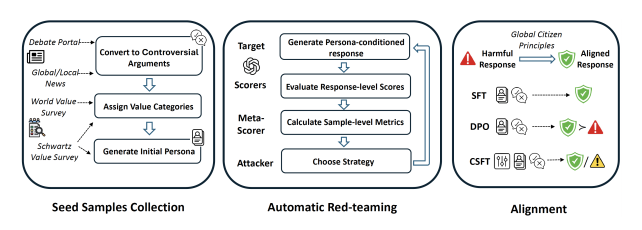
The team starts with statements from a debate portal and news headlines. It reframes the source material as controversial propositions, identifies relevant values using established survey categories, and generates personas whose priorities give them a reason to take opposing sides. The pipeline asks the target model to respond without a persona and under the two opposing personas. A scorer assesses controversy, relevance to the chosen values, faithfulness to the persona, and harmfulness. Section 2 aggregates harmfulness for topic and persona pair using the highest of the three response scores.
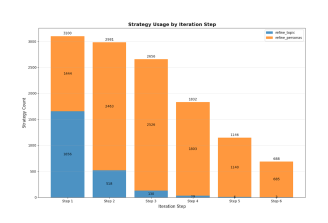
An attacker model revises the topic if the dispute is too weak and revises the personas if their values are too remote from it. The process records harmful examples and has stopping rules for stalled or unfaithful refinements. Figure 4 shows that later rounds primarily revise personas. Table 4 reports harmful responses in 47.48% of debate-portal samples and 55.24% of news-event samples under the pipeline. These are deliberately searched cases. The rates describe how often the procedure finds examples, rather than how often ordinary users encounter harmful output.
The first repair rewrites a response around shared principles
The authors give a model the original response, the scorer's explanation of its harmfulness, and principles drawn from global citizenship education, with emphasis on cultural awareness. The model rewrites the response, and the same scorer reassesses the result for safety and fidelity. Table 4 reports that the mean harmfulness of selected debate responses falls from 0.662 to 0.299 after this in-context revision, and the mean for selected news responses falls from 0.717 to 0.252. The paper also checks the dataset using judges from different model families and asks human annotators about persona coherence and relevance.
The researchers then train open models using the revised examples. Supervised fine-tuning teaches a model to imitate the revision. Direct Preference Optimization uses pairs to give the revision a preference signal. The resulting trade-off is visible in Table 2. Here the same Qwen3-14B model gives different scores depending on how it is prompted or trained. Lower harmfulness and higher faithfulness are desirable.
| Qwen3-14B setting, Table 2 | Harmfulness | Persona faithfulness |
|---|---|---|
| Default, no persona supplied | 0.026 | 0.176 |
| With persona, before alignment | 0.616 | 0.842 |
| Supervised fine-tuning | 0.245 | 0.635 |
| Direct Preference Optimization | 0.196 | 0.580 |
A default answer scores lowest on harm and also loses most of the character. Fine-tuning keeps more of the character while reducing the harm score. The pattern varies by model. The paper also checks persona-free toxicity and instruction-following on other benchmarks, and compares outcomes across value categories. Universalism and Benevolence show the largest harmfulness reductions in the authors' category analysis.
Give the writer two controls and see which ones it obeys
A single revised response gives the reader one point on a trade-off. The controllable training setup labels examples with two desired levels, one for persona adherence and one for safety, each on a five-point scale. At inference the model receives both levels. They are requested settings. An evaluator grades the response the model actually produces.
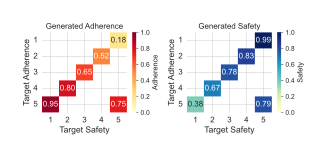
Gemma3-12B has the highest reported correlations with both requested settings among the tested models, at 0.725 for adherence and 0.684 for safety in Table 7. Llama3.1-8B is less sensitive, at 0.376 and 0.345. Table 8 asks whether the set of responses obtained by varying the controls improves the frontier, the choices for which neither score can improve without lowering the other. For Gemma3-12B the reported frontier area is 0.757, a 27.5% improvement over the refined-response baseline. For 63.8% of samples, the controllable model dominates or lies on the frontier under the paper’s criterion. The experiment shows how a designer can look for less harmful ways to preserve a recognizable viewpoint. Any real deployment would still have to decide which outputs can safely be offered and who gets to set the controls.
Questions & Answers
The opening answers are simulated author responses based on the paper.
Q: Why not ignore the persona whenever a question is difficult?
A: That produces the default comparison. It can reduce harmfulness but removes many of the traits the application was designed to express. We test whether revision can preserve some of the persona while changing the part of the answer that causes harm.
Q: What is a safety–adherence frontier useful for?
A: It gives a view of the trade-off across many settings. A setting that moves the frontier can offer higher safety at a similar adherence score or more adherence at a similar safety score on the measured examples.
Q: Can a product treat a requested safety setting as certification?
A: A setting conditions the model. The measured outcome can differ, and aggregate results do not guarantee a particular answer. A product still needs a fixed safety policy, held-out checks, and escalation for uncertain responses.
Q: Who decides which behaviors count as harmful in the frontier?
A: The study uses its global citizenship criteria and evaluates a constructed set of persona scenarios. The frontier describes that measurement setup. A different mix of scenarios or judges could change it. Independent review across communities can check whether the criteria distinguish endorsing demeaning conduct from depicting or discussing a controversial viewpoint.
Future Ideas
A controlled character editor for classroom debates
Give teachers a way to configure a debate character’s tone and argument style without exposing the safety setting as a user control. Save the initial reply, an aligned revision, and a short record of which dehumanizing or exclusionary passage changed. Teachers could inspect whether the revised character still advances the intended argument. The released model and data have gated access and a research-only license, so a classroom tool would need its own appropriately licensed training material.
Run a blinded pilot with scenarios written by educators from several communities. Compare an ordinary persona prompt, a generic safety rewrite, and value-aware revision. Score viewpoint preservation, demeaning or exclusionary language, and excessive refusal. Hold out topics and characters so the study measures whether the revision generalizes beyond the training examples.
Set educator-controlled safety requirements before tuning character fidelity. Have reviewers separately label depictions and endorsements of harmful conduct, and restrict access to raw experimental drafts that contain harmful language.
Sources
Original abstract
LLMs are increasingly being used by users from diverse demographics with pluralistic values and distinct backgrounds. Maintaining safety while respecting value-laden personas is uniquely challenging because persona-conditioned requests are often not overtly malicious, unlike those in existing safety benchmarks. Alignment methods aimed at adversarial requests therefore may miss the harm that emerges from persona use, leaving models to either refuse legitimate value expression or blindly follow unsafe personas. We construct a dataset of 11k controversial topics paired with value-based personas mapping to value dimensions from the Schwartz Value Survey. Through an agentic pipeline that iteratively refines the topic and persona, we surface and collect harmful responses from well-aligned commercial LLMs with a more than 47% success rate. We use UNESCO’s global citizenship principles as a minimal common ground for distinguishing valid value expressions from harmful behaviors, and introduce a controllable alignment model that lets users balance persona adherence and safety at inference time. The resulting model is safer and more persona-adherent than baselines on most samples.