Overview
An answer near the top of a page is easy to see. A favorable vote count can make it more attractive after someone sees it. These two advantages can reinforce one another. The poster asks how to measure that feedback and how much it differs across online communities.
Key Findings
A vote starts with an opportunity to be seen
Two answers may solve the same problem. The one at the top of the page has a better chance of being read. If it already has several favorable votes, those visible judgments may also affect the next vote. The authors use the term Evolution of Excellence for a framework that studies how these forces compound as readers judge answers. The premise is that a helpfulness total can reflect both the quality of the answer and the opportunities it had to be evaluated.
Separate the position effect from the reaction to other voters
Position bias concerns where a reader encounters an answer. Herding concerns how earlier votes influence the reader’s judgment. They can reinforce each other when the ranking uses votes: a favorable score can lift an answer, and a higher position can attract more votes. The poster proposes measures of information monopoly to examine when this process concentrates attention on a response. The conference abstract outlines the framework. The author’s journal draft gives the underlying analysis and measures.
Compare the feedback across 120 communities
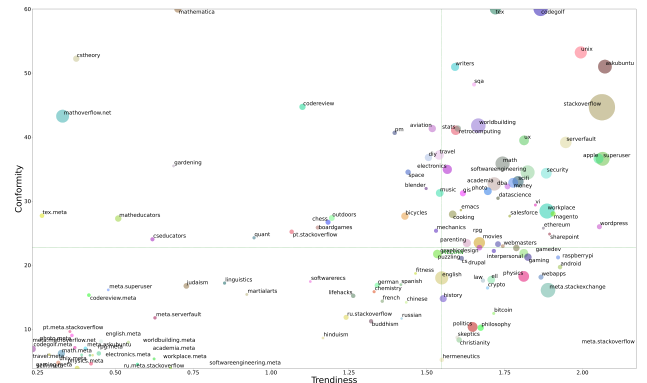
The team maps 120 large StackExchange communities along two axes. In the journal draft, Trendiness measures how strongly votes concentrate on answers that are already high in the ranking. Conformity measures how much new votes align with the majority already visible to the reader. Stack Overflow and Ask Ubuntu score high on both axes. MathOverflow and Theoretical Computer Science have relatively high conformity and much lower trendiness. The draft treats the four regions as descriptive groupings and tracks how selected communities move over time.
Track how long the front-runners stay ahead
The journal draft measures concentration of votes and persistence in the ranking separately. Its rank-persistence statistic asks how often one of the dominant answers occupies first place after the first dominant answer is posted. For the three dominant answers together, the statistic exceeds 80% in all eight illustrative communities in Table 4, from about 81% on Code Golf Meta to about 94% on Politics. The table measures persistence in observed rankings. It does not tell us whether those answers deserved the lead.
Use those differences to ask where a ranking intervention could help
The proposed framework gives a site operator separate questions about visibility and voting. For example, rotating the order of answers would test the first mechanism, while temporarily hiding vote counts would test the second. Those are ways to build on the poster’s distinction. The conference abstract does not report randomized interventions or establish how much either change would help.
Questions & Answers
The opening answers are simulated responses based on the conference abstract.
Q: Can a popular answer also be excellent?
A: Yes. The problem is that votes can mix information about usefulness with information about exposure. Measuring the two separately helps a platform see where a high-quality answer may be overlooked.
Q: Why compare communities?
A: A ranking policy can have different effects where users view and vote on answers differently. Community-level comparisons can help identify where an intervention is worth testing.
Q: Can the poster isolate what caused an answer to rise?
A: The public abstract motivates the distinction between exposure from order and herding from visible counts. Observational patterns can also reflect when answers arrived, who visited, or the questions different communities ask. The journal draft defines the two measures and illustrates them across communities. Independently changing order and vote visibility would give a stronger test of the two mechanisms.
Future Ideas
In a moderated knowledge forum, rotate two already eligible answers for a small, randomized sample of readers. Cross the rotation experiment with a second randomized assignment that hides vote counts. Set the sample size in advance. Measure impressions, voting, and independent assessments of helpfulness. Compare the exposure effect across communities and assess whether the poster’s behavioral categories predict which forums benefit from rotation.
Before using an estimated community pattern to choose an interface, check whether it persists across time windows and predicts the randomized effects on later discussions. Treat the observed groupings as exploratory until they predict the results of such an intervention.